Computer Engineering Student at KU

Prakash Chaudhary

I'm a developer and AI trainer who happens to be a professional beginner. I know enough to build useful things, and I'm curious enough to keep learning. History taught me patience. Tech taught me speed. I'm still figuring out the balance.

TypeScriptPythonCanvas 2DReact 19Next.jsTanStack StartTailwind CSSViteThree.jsGSAPFastAPIWebLLMLLaMA-2MistralmBERTWebGPUSupabaseIndexedDBWeb Push APIWeb Audio APITypeScriptPythonCanvas 2DReact 19Next.jsTanStack StartTailwind CSSViteThree.jsGSAPFastAPIWebLLMLLaMA-2MistralmBERTWebGPUSupabaseIndexedDBWeb Push APIWeb Audio API
Scroll

About

The evidence file

I'm Prakash, a developer with a chronic inability to leave a good question alone. Show me a working app, and I will immediately want to dissect it. Show me a headline about a 200-year-old revolution, and I will genuinely want to know what the weather was like that Tuesday. It's a glitch in my personality, but it works.

Over the past four years, that particular brand of obsession has turned into actual, shipped code. I've built autopilots for drones that panic when GPS drops out, chatbots with better memory than I have, and tools that catch fake news before your uncle can hit "forward." None of it started with a grand master plan. It usually started with me squinting at a screen thinking, "Wait, can this even be done?"

I also read way more history than people expect from a guy who spends his days debugging. Studying old empires taught me patience. They prove that things always take longer than planned and rarely go the way you expect. Tech, on the other hand, taught me pure speed. Ship it, break it, frantically fix it, ship it again. I'm still figuring out where ancient Roman patience meets startup speed, but this portfolio is basically the evidence file.

History nerdProfessional question-askerStill figuring it out
4+ yearswriting code

Patience

History taught me patience.
Tech taught me speed.

Speed

Award-winning work

Flagship projects

Two competition-winning systems, built end to end — hardware, models, and the interfaces that make them usable.

1st Place — Gemma for Route Intelligence

The Kairos Engine

A Cognitive Autopilot for BVLOS Mountain Drone Delivery

Built for Build With Gemma: Margadarshan, winning first place in the Gemma for Route Intelligence track. It gives a delivery drone something it has never had: judgment.

Read the full Kaggle writeup
97.40%
XGBoost test accuracy
<2s
On-board re-planning
Pi 5
Runs fully on-drone
1st
Place, Margadarshan

Problem

Today's delivery drones fly like trains on a track — when wind or battery fails mid-flight, the only fallback is Return-to-Launch. In the Himalayas that move is often fatal, because home may sit behind a 4,000 m ridge the drone cannot clear. The Kairos Engine is not a flight controller; it is a decision-making brain that sits on top of one.

Approach

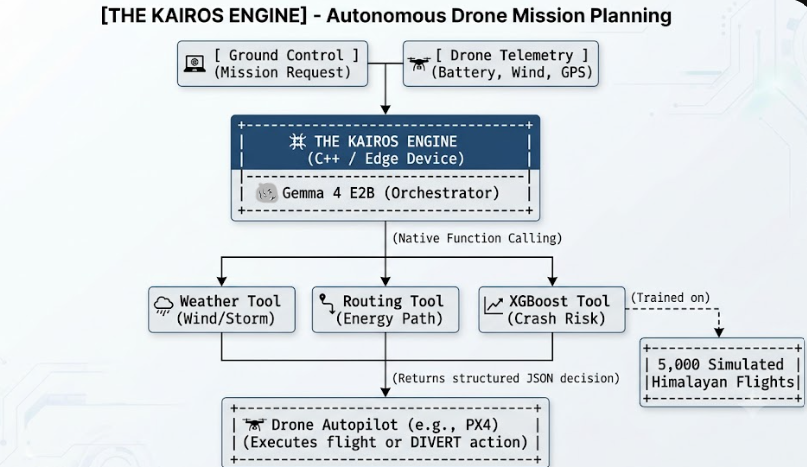
Gemma 4 E2B runs the show — reading telemetry, calling the right tools (wind forecast, nearby safe landing spots, payload urgency), and looping sense → reason → act. An XGBoost model trained on 5,000 simulated Himalayan flights scores the crash odds for each move (fly home = 92%, divert = 5%) at 97.40% test accuracy. A weighted-Dijkstra pathfinder optimising energy, not distance, beats a naive shortest-path A* baseline.

Result

Mission Success Rate lifted across 20 random scenarios — each landing with over 15% battery to spare. The whole brain runs on the drone itself: Gemma shrunk to 4-bit (GGUF) on a llama.cpp runtime, even on a Raspberry Pi 5, so it keeps thinking when the ground link drops, re-planning in under 2 seconds. Every decision is logged, giving regulators (CAAN, FAA) the auditable trail BVLOS laws have been waiting for.

  • Gemma 4 E2B agentic tool-calling
  • Energy-aware weighted Dijkstra
  • Runs on-drone (4-bit GGUF, Pi 5)
  • Auditable decision logs for BVLOS
Gemma 4 E2BXGBoostPythonC++llama-cpp-pythonGGUFWeighted-DijkstraRaspberry Pi 5PX4/ArduPilot
kairos-engine / architecture
The Kairos Engine architecture diagram
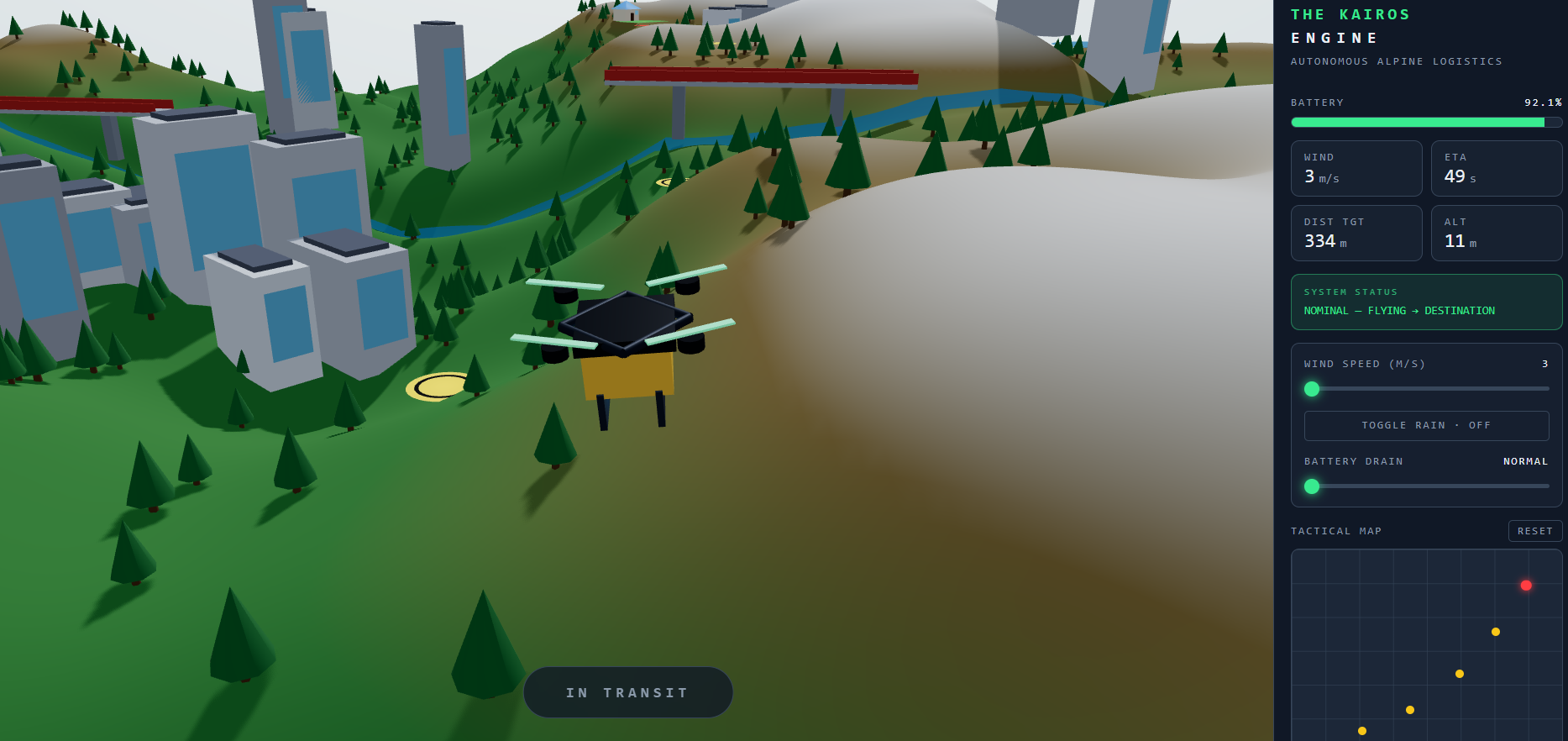
kairos-engine / simulation
3D drone delivery simulation with live telemetry panel
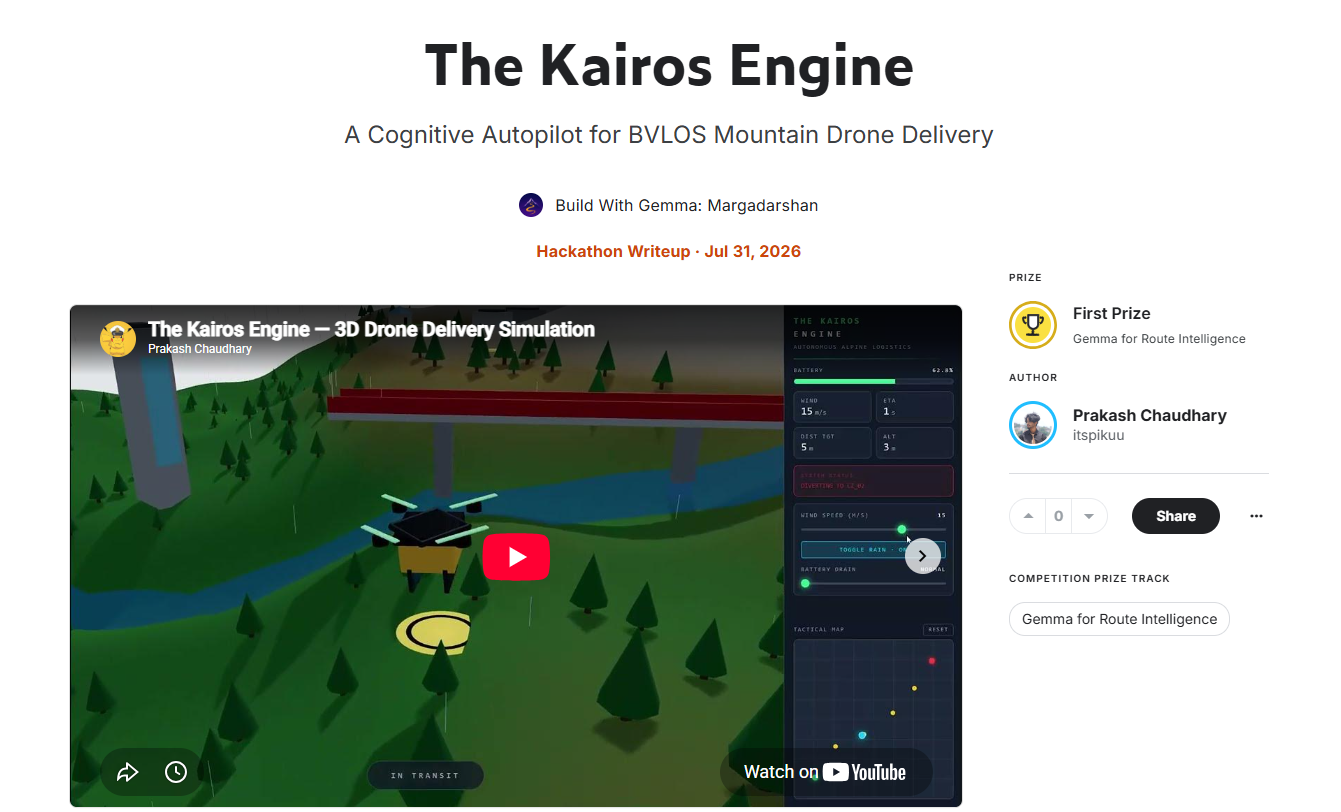
kaggle.com / margadarshan writeup
Hackathon writeup page showing first prize
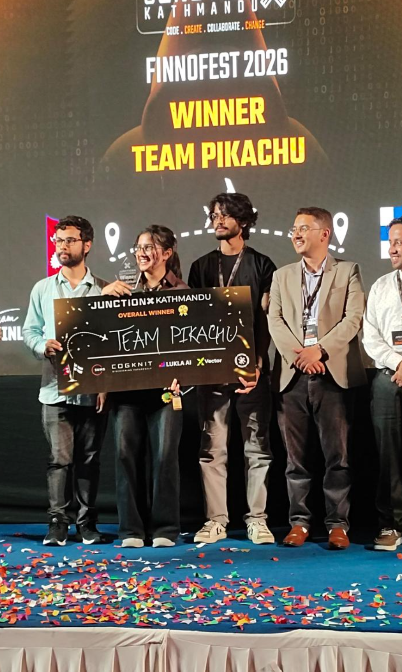
Track & Overall Winner — JunctionX Kathmandu

Fluvius Predict

A live digital twin for hydropower river forecasting

Built for the JunctionX Kathmandu Hackathon. We won the track and the overall competition, and we'll be representing Nepal on the international stage in November at the Junction Hackathon in Helsinki, Finland.

24h / 7d / 30d
Forecast horizons
0
Manual river dives
Live
3D digital twin
1st
Track & overall

Problem

Hydropower plants currently rely on manual measurements and decades-old data, leading to costly grid penalties.

Approach

Fluvius Predict uses Rodalo, a robotic scanning device that continuously measures river depth and speed without dangerous manual labor. This live data feeds into an AI model that constructs a dynamic digital twin of the river, combining rain radar and snowpack data.

Result

Highly accurate 24-hour, 7-day and 30-day forecasts, with operators getting one clear number for exact energy generation potential. We successfully built a 3D digital twin model using year-round data of the Kali-Gandaki hydroplant to demonstrate this.

  • Perfect Grid Declarations
  • Maximized Profit
  • Zero Danger Hardware
  • Live 3D Digital Twin
AI ForecastingRodalo Hardware3D Digital TwinRain RadarSnowpack Data
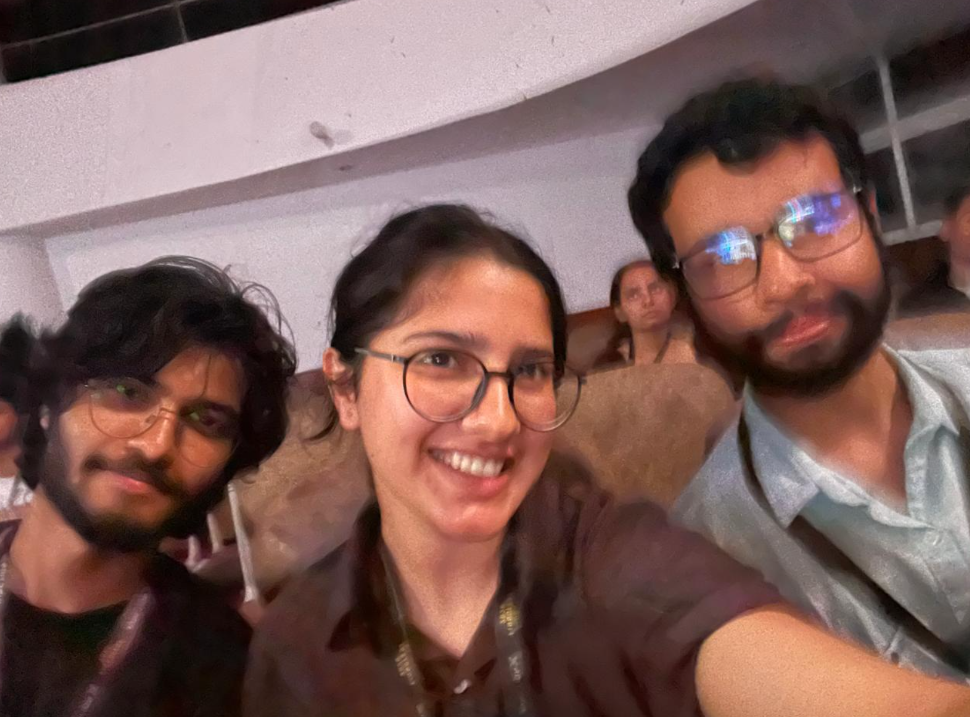
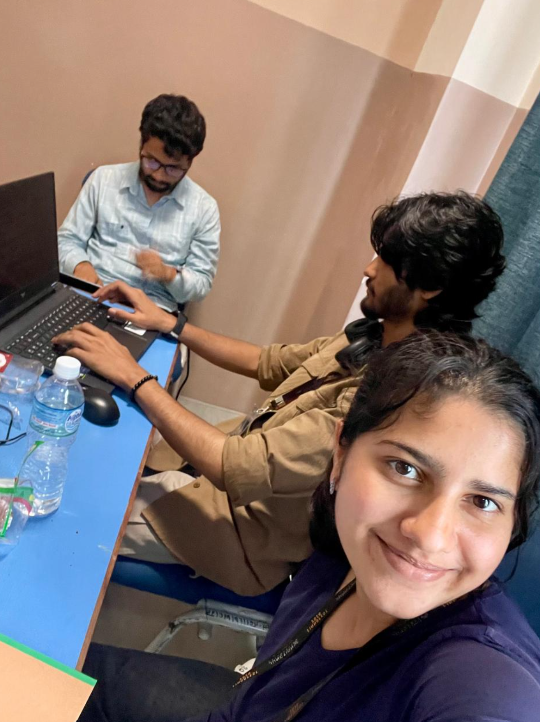
Team celebrating at the event
Team Pikachu — JunctionX Kathmandu overall winnerTeam hacking during the competition

Selected work

Other projects

A mix of shipped tools, research, and experiments across AI, web, and 3D.

piku-s-cat
Piku's Cat preview

Piku's Cat

Ongoing — in development

An immersive, browser-based anime adventure game built around the bond between a boy and his cat. The narrative takes players from a quiet Japanese village through Edo streets to a moonlit pagoda. It features a complete custom systems suite — point-and-click movement, raycasting interactions, washi-scroll dialogue UI, and an inventory. A procedural music system via Web Audio API and a 'never stuck' guide that auto-resolves after idle time ensure a seamless, cinematic 3D experience rendered entirely via Three.js.

  • Three.js 3D rendering with UnrealBloomPass
  • Point-and-click movement
  • Procedural music via Web Audio API
  • Canvas 2D sprite generation
  • "Never stuck" idle guide system
Three.jsGSAPWeb Audio APICanvas 2D
pikubot
PikuBot preview

PikuBot

Ongoing — in development

Portfolio sites are usually static, you read about someone, but you never actually talk to them. PikuBot fixes this by acting as a digital clone of me that visitors can chat with naturally. It knows my story, my skills, my opinions, and my personality, and it remembers every conversation to keep replies context-aware. Built with an open-source LLM running entirely in the browser via WebLLM and WebGPU, it requires no backend servers, no API keys, and keeps all data private on the user's device.

  • Remembers every conversation
  • Runs 100% client-side in the browser
  • Responds with my personality and knowledge
WebLLMReactTypeScriptWebGPUIndexedDBViteMLC
manavaai
ManavaAI preview

ManavaAI

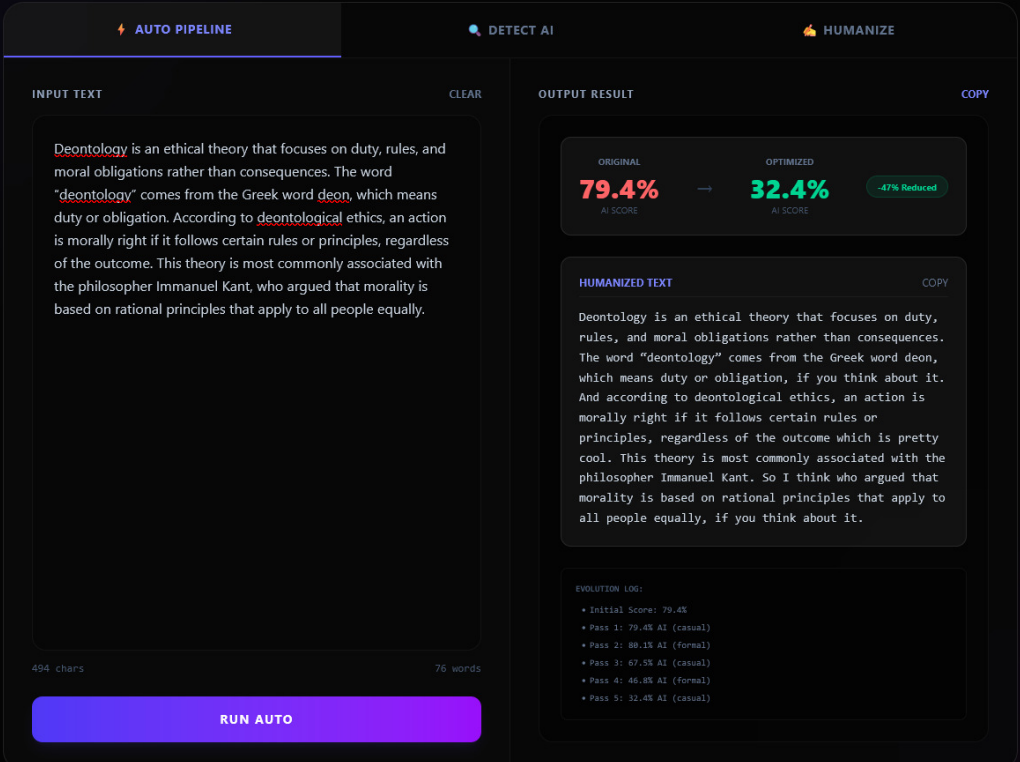
AI-generated text often sounds robotic and lacks human emotion. ManavaAI bridges this gap by identifying robotic patterns and rewriting them to sound natural and highly readable while preserving the original meaning. The system leverages advanced models like LLaMA-2 and Mistral, fine-tuned with a specialized LoRA technique to excel at human-like writing. Built with a FastAPI Python backend for AI processing and a React/Tailwind frontend, it helps students and professionals create authentic, human-sounding content.

  • LoRA fine-tuning
  • Detects robotic patterns
  • Preserves original meaning while improving readability
LLaMA-2MistralFastAPIPythonReactTailwind CSS
veritasnp
VeritasNP preview

VeritasNP

The rapid spread of misinformation in Nepali-language media is unaddressed due to a lack of labeled datasets. VeritasNP constructs the first benchmark dataset for Nepali fake news detection by scraping credible sources like OnlineKhabar and Ekantipur. After standard text-cleaning pipelines, the headlines are classified using five models, including TF-IDF features for classical models and transformer embeddings for deep learning. Our comparative analysis proves that multilingual transformer models (mBERT, MuRIL) outperform classical approaches, establishing a foundational resource for Nepali NLP research.

  • BeautifulSoup scraping pipeline
  • TF-IDF features for classical models
  • Transformer embeddings for deep learning
Logistic RegressionNaive BayesSVMmBERTMuRILPython

A Square Academy

A dark-themed, premium, two-sided education marketplace built specifically for Nepal, connecting students with tutors for in-person and online learning. The platform features privacy-safe tutor cards where contact info is masked until a request is accepted. It includes dedicated dashboards for students (enrollment, tracking) and tutors (request inbox, course studio, earnings), alongside a comprehensive admin console with user verification and a root admin lock. Tied together with real-time chat and an immersive 3D hero background, it provides a complete local tutoring solution.

  • Two-sided marketplace
  • Masked tutor profiles for privacy
  • Course studio & live session booking
  • Admin console with root admin lock
React 19TanStack StartTailwind CSS v4Three.jsSupabaseLeaflet
kupals
KUPals preview

KUPals

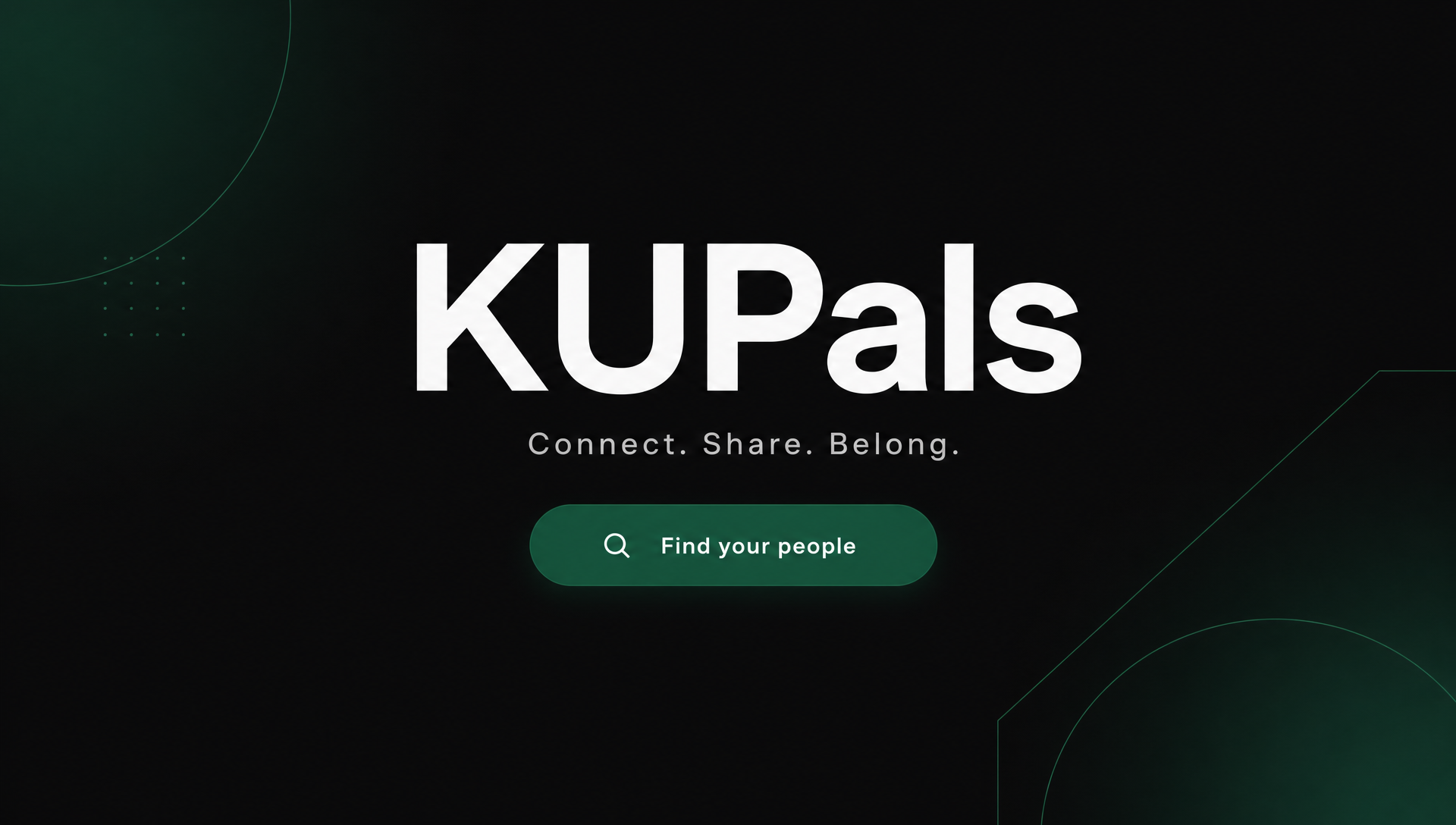
A lightweight social platform designed for Kathmandu University students to bridge the gap in centralized academic networking. It allows students to discover public interest groups (coding, music, hiking) or create private, invite-only groups for focused discussions. Built on a scalable Firebase architecture, it features real-time chat, secure Google/Email authentication, and a responsive UI. Data privacy is enforced directly at the database level using Firestore Security Rules.

  • Public & private groups
  • Real-time chat
  • Secure authentication
  • Granular privacy rules
React.jsNext.jsFirebase AuthFirestoreFirebase Storage
sweetcycle
SweetCycle preview

SweetCycle

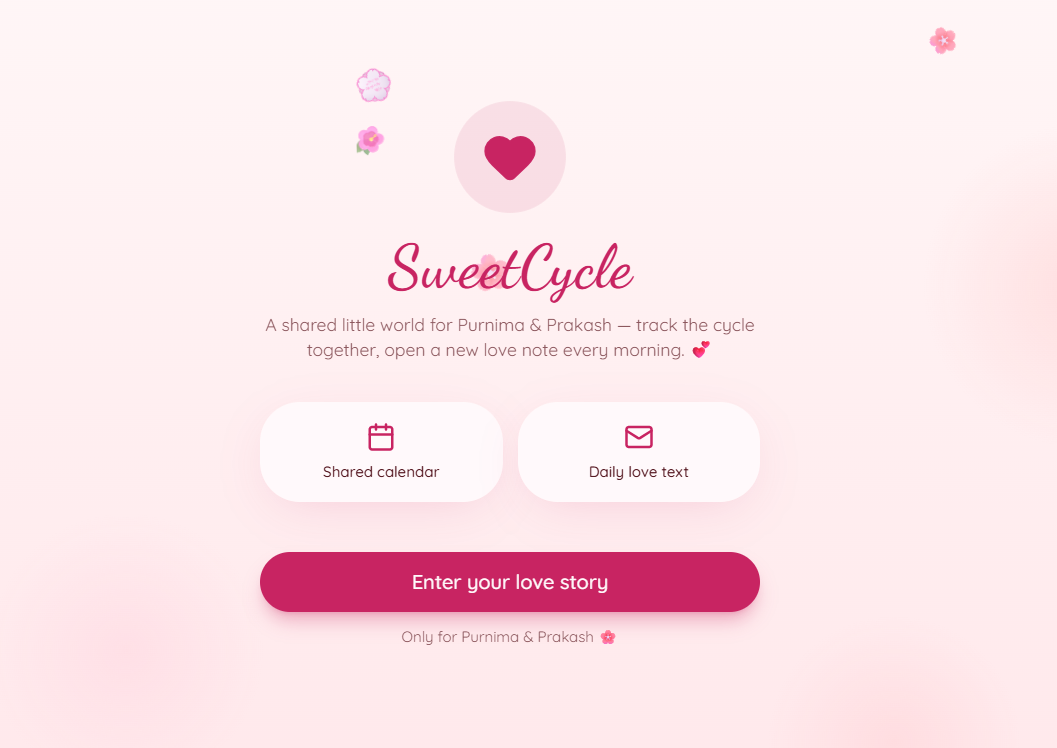
A private, couple-focused Progressive Web App (PWA) combining a shared menstrual cycle tracker with a daily surprise love-text system. Built strictly for two users, the database enforces unique roles for absolute privacy. It features a shared calendar predicting periods and ovulation based on logged data. The standout feature is a daily love-text system where one partner schedules notes that the other unlocks each morning, with future notes hidden via Row-Level Security. It includes automated push notifications and a cute, mobile-first floral UI.

  • Shared cycle predictions
  • RLS-protected daily surprise notes
  • Web Push notifications
  • PWA offline support
TanStack StartReact 19SupabaseWeb Push APIVite 7

Contact

Let's build something

Open to internships, collaborations, and any problem that starts with "wait, can this even be done?"

itsprakashhchaudharyy@gmail.com